Entries Tagged 'timetrials' ↓

Position on A Time Trial Bike

tt

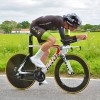
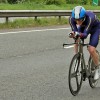
Time Trials is all about aerodynamics. Therefore, the most important thing is reducing the frontal area. The ideal is a flat back because the wind flow is much reduced. However, don’t force yourself to have a flat back if it is not comfortable. Lance Armstrong had a curved back and it never did him any harm (see:pic). Also, if you are not used to riding at such a low position, then gradually reduce the height.

  • Even if you don’t do time trials, it may be worth thinking about your position on a road bike. Comfort is more important than on a time trial bike, but, maybe a few changes can decrease wind resistance with little negative effect.
  • Note: there comes a point when lowering the tribars can start to decrease power because breathing is slightly restricted. It becomes a trade off between aerodynamics and power.
  • In the picture above notice how much lower the tribars are compared to the saddle.
  • The second most important thing is bringing in the arms. On a road bike they are about 42cm apart. But, using tribars you can bring the arms closer together and reduce the wind resistance. Continue reading →

Time Trial Races in The UK

Time trial racing , is one of the most popular forms of bike racing in the UK. Unlike the continent, Britain struggled to organise road racing in the first half of the twentieth century. It stemmed from a legal challenge to ‘mass start races’. Basically at the turn of the century, the motorist lobby was more powerful than the cyclist lobby, and there was a successful campaign against bike racing which ‘terrorised the poor motorist’. To get around these restrictions on mass start races, people organised races, where cyclists would go off at one minute intervals. If challenged by the police they could just say they were going for a ride by themselves. In the early days, time triallists wore black to ‘look inconspicuous’. It is also suggested that there was a necessity for developing a secret code for race circuits to avoid detection. This is why in the UK, you will hear about courses such as the U808 or the H25/10b e.t.c.

Even after road racing was allowed, the UK cycling authorities struggled to make the shift to road racing. They had grown fond of time trials and saw road racing as ’something for the continent’ This led to a deep and unnecessary rift within British Cycling, which exists even today (although much less than before). Time trials were a strictly amateur affair. To enter road racing meant you had to forsake the amateur challenge of time trials.

Continue reading →

What To Think About During A Race?

In a race, we are faced with physical pain and a long time to ourselves. There is little to distract the mind apart from the race at hand. Our mental attitude to the race can have a big bearing on how we perform and whether we are able to reach our maximum potential. I am particularly interested in this question, because I practise meditation and concentration exercises. Meditation is essentially, the art of silencing the mind and so I try to use these techniques when racing.

Thinking of Nothing.

It might seem difficult to think of nothing, but, if we can keep the mind clear, it provides greater focus. With focus and concentration we can reach our maximum potential more easily. When we start following random thoughts like what we need to do next week, we weaken our ability to maintain our race intensity; we are more liable to listen to the pain of the body and slow down.

Concentrating on Breathing / Rhythm of Cycling

The thing I love about cycling is that it has a certain rhythm. You can feel this, especially when you keep a constant high cadence. It is good to focus on this constant motion and keep all your attention on maintaining this rhythm. Alternatively it is good to focus on your breathing; as you breath in, you can feel that you are breathing in tremendous energy. If you fix all your attention on an aspect of your cycling like the pedalling motion or your breathing, you will get less distracted by random thoughts which slow you down.

Continue reading →

Training for a 10 Mile Time Trial

A Ten Mile time trial can taken anything between 17 minutes (over 32mph) and 35 minutes. A good target for a fit club cyclist is to break 24 minutes. This requires an average speed of 25mph and is often called ‘evens’. This is the average speed to break the hour for 25 miles.

Tips for Training for a 10 mile time trial.

1. Mileage. The good thing about racing 10 mile time trials is that you don’t need to do large volumes of miles. This makes it attractive for the racer who can’t spend all day riding. However, to make the most of higher level training, it is still important to build up a base of ’steady’ miles first. If you are new to cycling it is more beneficial to build up a reasonable level of base fitness than jumping straight into racing. A good base for 10 mile time trials is perhaps 100 miles a week. If you do more, it may have a marginal benefit; but is not essential.

2. Intervals.

Early in the season, I may do interval sessions of 5 minutes which are close to ‘race pace’. This will vary from individual to individual. But, for myself, it involves training at a heart rate of 93-5% max (or 184-190) The gap between the intervals might be quite a long time in the early season. But, shortening the gap between the intervals will make them of increasing benefit.

3. Intervals above Race Pace.

I feel it is this training where you really feel you make progress in increasing your speed. Basically, the aim is to keep a pace that would be difficult to maintain in a race for 20 minutes. It is the pace, that involves going a little into the red zone. You will feel the build up lactic acid and it will require considerable effort to maintain your effort at this level. Typically, it is a heart rate of 95% or greater; but, it is not a flat out sprint. I find it easiest to do this kind of training on a long hill with a gradual gradient. I like to maintain a similar position to time trial and a high cadence. If you can do 3-4 intervals at this effort level, then it is a very good training session. In practice, you will find that by the third of fourth it is not possible to maintain the high intensity; don’t worry.

Continue reading →

Using Cycle Computers for Time Trials

Readers Question from Andy - Where do you stand on the use of the computer in a TT? I only show my HR and my speed, but I’m not sure how much use it is - might even have the effect of depressing me and taking my mind of my pedalling, breathing etc. I’d welcome your thoughts. (from: tips for time trials)

It’s a good question and you will probably find different cyclists have different opinions.

When I first started racing, I always used Heart Rater Monitor and speedometer.

Using Heart Rate Monitor in Time Trial

Using a HRM, can be a rough guide to whether you are going too hard. But, the problem is that it varies quite a lot. For example, on a hot summer evening, you will have a higher average. On a cold sunday morning the average heart rate will be 5-6 rates lower. Now, I choose not to race with a heart rate, I prefer to work on trying to ‘feel’ the perfect racing effort. If you can learn this through trial and error, it will be more effective than a heart rate.

The other option is to use a heart rate with downloadable function and then not look at it during the race, but use it for analysis afterwards.

Others may say Heart Rate Monitors can be good for maintaining constant effort. But, you have to be aware, the HR may  decline during the race. At least, it might prevent you going off to fast at the start.

Continue reading →

Tips for Racing Time Trials.

time trial

Having done quite a few time trials these are some of the important things I have learnt in the process of racing

  • Prepare Equipment and test in advance. On quite a few occasions, I made last minute changes to equipment and then found that they didn’t work whilst racing. I remember one 31 hilly mile time trial where I raced the last 15 miles with the time trial bars facing 20 degrees to the left. Before the national 100 mile championship, I found my handlebars were loose, just 3 minutes before my start. Fortunately another rider carried an allen key, otherwise I would have never have raced.
  • Give time to arrive. There is nothing worse than frenetically driving through unknown country lanes trying to find the hq in time to make the start. Despite giving myself this advice repeatedly, I seem to still make the same mistakes.

Racing.

  • Don’t start too quick. A common mistakes for beginners is to sprint off from the line and exert too much effort in the opening 5 minutes. What happens is that the anaerobic effort leads to a quick build up of lactic acid in the legs and you then spend the rest of the race dealing with this. It is best to see the first 2 minutes as an acceleration upto race speed. Then try and maintain this constant pace throughout the race. Continue reading →

Easy Ways to Improve Aerodynamics.

 tejvan pettinger

These are a few simple ways to increase the aerodynamics of your riding position. They are primarily intended for time trials, although, some may also be appropriate for road racing as well.

  • Oversocks - Oversocks are a lycra fitting for your shoes. These help improve airflow by creating a smoother covering of the shoe.
  • Single Chainring - For many time trial courses, it is not necessary to have a double chainring at the front. If you are averaging 25mph, you will not need the inner ring, unless the course is very steep in places. A single ring enables you to remove the front mech changer as well. However, if you do this be wary you don’t enable your chain to slip off. Continue reading →