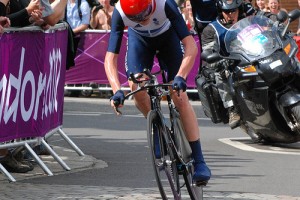
Just a brief note to say congratulations to Nicole Cooke for becoming World Road Race Champion in Varesse. Nicole Cooke becomes the first female cyclist to win the Olympic Road Race and World Road race Championship in the same year.
Nicole won a tactically astute race, to sprint past former world champions Marriane Vos (Netherlands) and Judith Arndt (Germany).
Even before her Olympic and World Titles, Nicole Cooke was ranked number 1 female cyclist in the world.
The Blenheim Palace cycling event seemed a great success. There were 100s of cyclists there - from eccentrics riding old penny Farthings, to the country’s top road racers and time triallists. In the middle, we were treated to the highly entertaining Brompton World Championships. After the official racing, we were able to ride around the 6 mile loop of Blenheim Palace. It was great to ride around such a beautiful, traffic free course.
Racing Round Blenheim on a Brompton (wearing a blazer, tie and shirt of course)
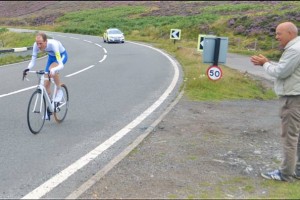
Today, I won my first race of the year. It was a 10 mile TT. My time was 22.37. Second place was Peter Weir 22.43 and Ian Greenstreet of Newbury RC came third in 22.45
The course H10/3 is fairly new and this was the first open event, so maybe I can claim a course record
Next year, the 2009 10 mile TT Championship will be held on this course. It is not quick, becuase it is undulating, with one sharp climb in the middle. It’s not really a proper climb, but, when your timetrialling it definitely knocks you out of your rhythmn.
Apart from the slowness of the course, it is actually quite good course. Traffic is light, road is wide, surface is smooth, there is only one roundabout at the turn. I will enter next year’s national 10 mile TT championship and see how I get on.
Anyway, it’s just nice to be cycling with great weather we are having here in the UK.
This brings to an end the time trial season. Now, it is just the hill climb season!
A Cyclist approaching a mini roundabout. If the cyclist was turning right, a majority of motorists do not give way, but keep going straight across the roundabout. If you are not aware that most cars will keep going, an accident is quite likely. This is on my commute home. It is very rare a car, will stop to allow you to go round the mini roundabout and come off. If you want to avoid an accident, the onus seems to be on the cyclist to give way to the motorist driving straight on.
Once I had a close shave with a car driving straight on through a mini roundabout. I came very close to the car. The motorist shouted - you should have signalled right. But, if you read the highway code, you would signal to come off a roundabout not stay on it.
Now, when I come to a roundabout like this, I do often signal right, and look very closely at the driver. I assume, I will have to stop and give way to the car. In rare cases (and it is surprisingly rare) they will let you go right.
What is there to say? Apart from never assume other road users will do what they are supposed to!
I’m sure that many drivers and cyclists don’t fully understand the rules of roundabouts. Also, many drivers seem to treat mini roundabouts with disdain.
In Oxford, I’ve noticed a big increase in the number of police patrolling Oxford on mountain bikes. The police have found that bikes are an excellent way of patrolling busy streets, especially in the evening. Bikes can cover much more ground than a bobby on the beat, but, they also offer greater flexibility than a car.
But, generally police on bikes is a good thing. People like to see a visible presence of police (even if they don’t have a huge effect in reducing crime). Also, if the police are used to cycling on roads it might make them more sympathetic to the dangers faced by the everyday cyclist.
After taking the photo at the top. One of the policemen came over and asked quite aggressively why I was taking photos. I said I like taking photos of people on bikes. He didn’t accept this but asked whether they were for the Oxford Mail. I don’t know why they were so worried, it’s not as if they were doing anything wrong. He did say, at one point ‘It’s not illegal to take photos of police, but, I want to ask why you are doing it.’
I was struck by the introduction to the introduction to this article in a Canadian newspaper:
“Winnipeg • I often get around town by bike. So curious is this behaviour to the Lexus-drivin’, lunch bag-packin’ crowd I encounter in suburban Winnipeg, that it is often discussed, sometimes behind my back. When it is to my face, at least I can defend myself. “I am not a hippy freak,” I say, oozing frustration and impatience, like Jerry Seinfeld when he started carrying a man bag. “I’m being European.”
I remember when I was a young lad of 16. I worked at a little chef about 3 miles away. For some reason I commuted in my full cycling gear. (3 miles seemed a long way in those days, and if your going to cycle why not cycle properly?
It never failed to gain the amusement of the workers that
a) somebody would cycle to work
b) somebody would come dressed to work in skin tight lycra tights (I did change when I got to work, I should point out.)
I don’t think I inspired anyone to try cycling to work, but probably reinforced cycling’s image as a quirky pastime for people lacking in basic fashion decency. But, it did prove an enduring topic of amusement (which is perhaps just a reflection of how grim working at the Little Chef could be…)
The other thing about cycling, was the persistent worries of my mother, who seemed to assume cycling was about as dangerous as parachuting from 500 metres. It felt like all the forces were against cycling; to be cycling you had to be pretty persistent which is perhaps why so few cycled to work.
Anyway, you now hear quite a bit about ‘cycling chic.’ Beautiful models riding gracefully around on their Amsterdam bikes. Aside from the image of the urban warrior cycling on pavements, cycling is almost cool these days.
A question for the readers - What do your friends and family think of cycling, and has their perceptions changed since you started cycling?
If you just cycle for pleasure or as a means to get from A to B, then feel free to skip this post
However, even if you are training for cyclo sportives or long distance rides, it may still be worthwhile doing some interval training. I’m a great believer that for long distances it is good to develop speed. My theory is that if you can cycle 10 miles quick, you will be able to cycle 100 relatively fast as well.
Interval training is essential for increasing your speed and power. At the moment I am doing a lot of interval training for the hill climb season that is starting soon. In a perverse way, I kind of enjoy it. At least, it gives a feeling of satisfaction.
Base Fitness
If you are new to cycling, especially if overweight or you haven’t done any exercise for a long time, you will be relieved to know interval training is not for you. It is vital to have a base level of aerobic fitness. If you are younger you may get away with less, but, you still need a certain base fitness before stretching your body to its limits.
Turbo or Road?
Some people swear by an indoor turbo trainer as a means to do intervals. It means you are:
insulated from bad weather,
protected from accidents.
Have greater control of your effort.
You don’t have to worry about stopping for traffic.
Don’t get punctures
However, despite these many advantages I have never seen the attraction of doing intervals on turbos. Usually when I get on a turbo, time seems to pass slowly and painfully. Somehow I prefer training on roads, even if it means getting wet. I will spend longer training up hills and on the road than on a turbo. If you have the patience to train on a turbo, I can only admire you!
Hill Intervals.
I think hills make a great place to do intervals on. It is a definite target to aim for the top of the hill. During most of the year, I am doing intervals of duration 4 -10 minutes. For these I tend to find long hills with a gradual gradient. My favourite hills are around the chilterns. For the hill climb season I am also using some hills of 2-3 minute duration. (Boars Hill and Shotover). These hill intervals are more intense than the longer intervals.
How Long Between Intervals?
Many training manuals may suggest a 5 minute interval followed by a 5 minute rest. However, I often take a long break between intervals. This is partly out of necessity; e.g. it will take 20 minutes to cycle from hill to the next. However, my theory is that by giving a longer recovery period, the interval is of a higher quality because you can give it more effort. It depends on what you are training for. For time trials, you need the ability to cope with lactic acid, therefore, intervals close to each other will help develop this - even if they are more painful.
How Many Intervals in One Session?
I always look forward to the first interval. The body is fresh and it is possible to give it everything. However, by the second interval the legs can already feel dead. It is also psychologically more difficult to motivate yourself to give the same effort a second or third time. Generally, I don’t have any target for the number of intervals, I just do them until I can’t do anymore. You can always cycle up a hill; but, if you can’t get a certain effort level and heart rate, you know you are not doing intervals anymore. On long training sessions, I may cycle somewhere else for 30-40 minutes and then you can do another one.
I wanted to make a short video, to introduce myself to readers, and also show how to put a new tyre on a wheel.
I was trying to show a technique to make it easier to roll a tyre on by squeezing it down and then pushing it on. Trying to concentrate on this and look at the camera at the same time, caused by thumb to get caught between the tyre and wheel - I have a small scar to prove it! so the video wasn’t very successful.
By the way, one of the great advantages of living on your own, is that no one minds if you keep your best bike in the dining room….
Anyway, one very useful tip for putting on a tyre. Always check to see whether the inner tube has got caught between tyre and wheel. One way to do this is to blow it up. If, in some places, the tyre wall is higher on the rim, it is a sign the inner tube has got caught. Deflate the wheel get rid of the nip and blow up again.
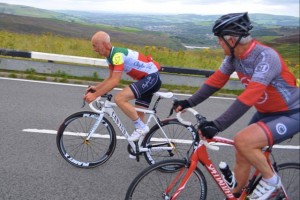
In road races, you often hear the advice to take a good wheel. - Basically, it refers to an experienced rider. A rider who will not cause problems, but is safe, alert and probably a strong rider with a good chance of doing well.
A good bunch rider will have the following characteristics
Physically fit and strong -able to respond to changes in pace.
Confidence. This is the confidence to know safe descending speeds, and safe distances from the front wheels. A confident ride will not allow gaps to develop or display hesitation. This is different to the arrogant over confidence some new riders may display. A confident rider will do the right things effortlessly.
Smooth Pedalling style. An experienced rider will keep his upper body still and pedal with his legs. A rider who is all over the place, gives signs he is tired or an inexperienced rider.
Smooth transitions. For example, when standing on the pedals, you can suddenly slow down, causing problems for people behind you. An experience rider, will change down gears and compensate for this potential slowing down. They will also make smooth transitions to new places in the group. They know which gaps can be taken and when it could cause a crash.
Concentration. Riding in a long road race means that you can easily lose concentration, especially when you are tired in the final stages. It is always important to be alert and aware of dangers. Most crashes stem from inattention and lack of concentration.
Signals. When riding in a group it is important to signal pitfalls like potholes or change of direction.
Holding Line. When you are riding on your own, you can take the shortest racing line round a corner. But, in a bunch, you can’t do this; you need to hold your line, if you start cutting corners, you will cause ripple effect throughout the bunch.
Smooth braking. Another important skill is to avoid sudden braking, this can cause a ripple effect throughout the bunch. Learn to brake gently, anticipating sharp corners, also use your body to act as a natural windbreak.