October 9th, 2008 — commuting-

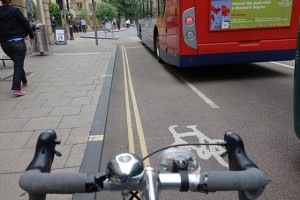
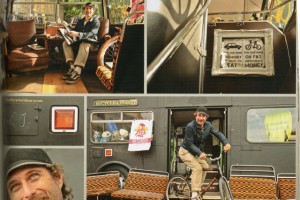
Good Shoes are essential for commuting, make sure you don’t lose them
In a previous post, I looked at factors which determine the % of journeys made by bike in a city.
These are tips for commuting, I have learnt from the past 10 years.
Don’t Worry. Cycling is perceived as a dangerous activity. However, in practice it is less dangerous than people may fear. The slight chance of being involved in serious injury, should be set against the health benefits of moderate exercise.
Enjoy It! Cycling can be difficult, bad driving, cold weather e.t.c. But, it can also be good fun. Driving into city centres at peak times stuck in traffic jams is pretty joyless; cycling gives you greater freedom. see: How to enjoy cycling
Do Wait At Lights. Many people cycling have a tremendous impatience to wait at a traffic light. Therefore, they will ride through lights often causing traffic to have to stop when they have the right of way. I see this everyday in Oxford. However, you will not enjoy commuting if you ride dangerously and inconsiderately. You will always be worrying and have nervous tension. If you change your attitude and accept waiting at lights, not riding on pavements, is the right thing to do, you will enjoy commuting alot more. Just set off 2 minutes earlier and give yourself time. Of course, you also won’t be breaking the law and putting your life at danger, see these as bonus benefits.
Panniers / Basket It is not pleasant to cycle with a heavy rucksack. It also makes it difficult to look over your shoulder. If you get a good basket and / or panniers you will be able to carry your shopping and increase the usefulness of your bike.
Practise Basic Maneouvres.
There are certain maneouvres which are important for defensive cycling. One important move is the ability to look over your right shoulder before turning right. If you can do moves like this you will have more confidence and be a better cyclist.
Anticipate bad Driving
Never expect other road users to be perfect drivers, you will soon be frustrated. Be careful at junctions and roundabouts where motorists may fail to signal or see cyclists. Cycling requires common sense, and the ability to predict possible dangers.
Avoid Dangerous Manoeuvres.
One of the most dangerous manoeuvres is squeezing along the inside of a heavy goods vehicle. This is quite a common cause of serious accidents as you can easily be invisible to the driver. When they turn left they can drag a cyclist underneath.
- You always have to be careful when cycling on the inside of cars. For example, a car may stop to allow another car to turn right. The cars may easily forget or be unaware a cyclist could be coming on the inside lane.
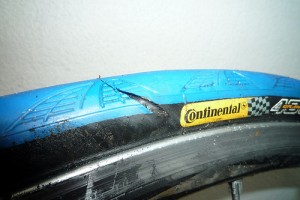
Puncture Proof Tyres. The best investment for a commuting bike is to buy Armadillo tyres. They are not completely puncture proof. But, since I have ridden them in the past 18 months, the number of punctures has dramatically fallen. The tyres also last for a long time.
Choose Your Route Carefully. The best route by car, may not be the best by bike. Choose a route you will enjoy cycling even if it involves a longer detour around busy road junctions.
You Don’t Have to Dress Like a ‘Cyclist’. There are some benefits of wearing helmets, fluorescent jackets. However, if you don’t want to wear these, you should not feel cycling is not for you. What you need is a good roadworthy bike and lights for when it is dark.
- Although, you don’t need to dress in lycra like a ‘cyclist’, I think it is important to be visible. This is something motorist often claim about cyclists - ‘I didn’t see you’. Therefore, there are definite advantages to being dressed in bright clothes and using lights, even in the fading light of the day.
October 8th, 2008 — bikes, cycling-

Whenever I buy a new bike, I always promise myself that I will always keep it spotlessly clean. In practise, my good intentions last for a few weeks. After a hard 3 hour training ride, giving your bike a proper clean never seems that appealing.
Nevertheless, since I keep one bike in my dining room, there is a good incentive to try and keep the bike clean. What I try and do is always give it a quick wipe to get the worst off. The problem is once you start, you want to get every bit of dirt off. Then it can become quite time consuming because it is really difficult to access all parts. But, you never regret cleaning a bike.
Some Tips for Cleaning the bike
- Use muguards on winter bike, to reduce the amount of mud to clean.
- Washing up liquid is great for removing oil.
- Don’t use a brush which is too harsh, as it may damage paintwork, especially on racing bikes with thin paint.
- For an impressive display, use a bit of WD-40 spray and then wipe with paper towel. This will help give it an impressive polish / finish.
- The best time to clean the bike is as soon as you return and in are in your cycling gear. Otherwise, it takes more effort to go back to the bike.
- I always clean a bike before taking it into a shop for repairs. I think shops dislike having to mend dirty bikes. If you clean it you are more likely to get a better service. It is also more respectful.
- You never regret cleaning your bike, because it does look good and will inspire you to go riding. A clean bike makes it easier to spot problems such as cracks in a frame, worn bolts e.t.c.
- Use special brushes for getting to awkward places.
- Turning the bike upside down, helps reach inaccessible places.
- If you have to hose down the bike, you will need to re lubricate the bike afterwards.
- At various times, you want to clean the chain with a degreaser machine.
October 7th, 2008 — cycling-

As a hobby, I like to take photos of cycling. Quite a rarity is to a see a cyclist smiling. Perhaps we are too busy concentrating on dealing with other traffic, or the effort of cycling. Nevertheless, when people see that you are taking photos, some will obligingly smile for the camera.
The only time when it was easy to catch people cycling and smiling was at Bleneheim Palace Cycling festival. No coincidence the cycling was on traffic free roads.

So anyway, if you see a tall, lanky person taking photos of cyclists in Oxford, smile and you might just become famous overnight (well, famous to the 20 readers of this blog anyway.)

This lady had spotted some friends on the other side of the road.
~

I think this is a smile. Ed Silverton enjoying the cyclo cross season.
~

Mike Potts shows his beautiful teeth - after Continue reading →
October 6th, 2008 — cycling-

Climbing Dover Hill hill climb. Picture courtesy Picton Photos
On Sunday, it rained all day. Not good conditions for a 2 stage hill climb.
Dover Hill 1 mile long, gradient not too steep.
Dover Hill will be used for the National hill climb Championships 2010
Matt Clinton, mikevaughan.co.uk cycles won in 4.01. 2nd was James Dobbin 4.05. Third was Robert Gough 4.13.3 I came forth with 4.13.8 ( 5 100ths of a second - is a pretty close margin)
I was freezing by the time I got to the car, thankfully, the car heating worked well and I had a spare set of clothes. 2 hours later it was the second climb up Saintbury Hill.
Saintbury hill 1.3 miles
- Matt Clinton 6.05
- James Dobbin 6.09
- Tejvan Pettinger 6.23
- Matt Higgins 6.27
Overall I came third which won me £30. Thanks to Alex Zebedee and Sollihul CC for organising and marshalling in the persistent rain.
Hill Climbs
October 6th, 2008 — commuting-
I got into cycling through riding long distances with a cycle club. The idea of commuting to school by bike never occurred to me. It would have been about a 9 mile commute into the centre of Bradford and unfortunately cycling didn’t seem very practical. I’m sure my mother would have raised many objections.
It was only on coming to Oxford that the bike became a means of getting to lectures and cycling around town. It may not always feel like it, but, Oxford is a bike friendly city.
- There are some bike paths.
- Distances are relatively small
- Cycling is usually quicker than driving
- Parking is very difficult in Oxford
- There are many other cyclists already. I think people subconsciously have a feeling of ’safety in numbers’ When there is a critical mass of people it encourages others.
- Pictures of Cyclists in Oxford
There is a huge discrepency between the % of journeys taken by bike in UK cities. In some it is very high, in others very low. In America, there are some cities where the rate cycling seems to be ridiculously low. The rate at which people will cycle depends on many factors. I think the most important are:
- Is there a tradition for cycling in the city? As mentioned before, the sight of many cyclists attracts others to give it a go.
- Layout of city. Is the road system conducive to cycling? How many dangerous crossings / right turns are to be negotiated?
- Cycle Paths. Are there well marked and well designed cycle paths? (note I say well designed as badly designed cycle paths can be worse than useless
- Climate. I’m sure rain is one factor which discourages cycling. Cycle rates tend to be higher in the South, where generally it is drier.
- Hills. Cities like Cambridge, and Amsterdam have an advantage because of the lack of hills. However, Bristol has a reasonable % of commuters cycling, and it is pretty hilly. People often use hills as an excuse not to cycle though.
- Cycle Policy. I think people are influenced by cycle policy. If city councils really promote cycling then people will be encouraged to cycle.
- Parking. One of the biggest factors that encourages people to cycle is the fact that driving a car is difficult. My old landlord only started to commute by bike when the University introduced parking permits. If you can’t park, cycling becomes much more attractive. City with the highest rates of cycling are often old historic cities, not built for the motor car. Cambridge, Oxford, York all have good cycling rates, because the motor car is discouraged from driving into the city centres. It is no coincidence cycle rates have increased in London since the introduction of the congestion charge made it more expensive to drive into the capital. I wrote a long economics essay on the negative economic effects of Free Parking.
What other factors do you think are important for determining the number of cyclists in a city?
October 4th, 2008 — cycling-

Top of Dover Hill
I turned upto a race, 24 hours too early today. For some reason, I thought race was on Saturday. I drove past the hq 3 times, because I was looking for cyclists in the vicinity. Because I didn’t see any, I thought it must be somewhere else. I was getting quite late by the time I finally arrived. When no one was in the car park, I thought Hmm, I must have the wrong day. Indeed, I looked at the start sheet and there it was - Sunday not Saturday!
I made so many small arrangements and plans for the race that I never thought I could get the day wrong!

Moreton in Marsh
O well, I got to ride the course beforehand like a true professional. It was two hill climbs - Dover Hill and Saintbury Hill. Thankfully, the race was only 1 hour drive from Oxford. Tomorrow morning I will go back - taking care not to leave my bike at home or something like that.
October 3rd, 2008 — cycling-

In previous posts, I examined how much space cars give bikes.
I came across a couple of links which made me go back to the issue.
The first is a study by Dr Walker, whose research was published in the journal Accident Analysis & Prevention [link]
Using an electronic measuring device, he found that when wearing a helmet, cars gave cyclists 8cm (3.1 inches). less space.
Interestingly, he found that the worst offenders were lorries and buses (buses got an extra 23cm closer. Something I can easily believe!). He also found that cars were more likely to give women extra room. (an extra 14cm)
His theory, is that car drivers make judgements about cyclists, if they look experienced then they give them less room. However, if the cyclist is not wearing a helmet the car driver worries that the cyclist is less experienced and more likely to behave unpredictably. Therefore, they give cyclists a wider berth.
I’m sure drivers don’t make a conscious decision like -”That person is wearing a helmet, so let’s pass close by.” But, when I’m driving I would take more care and pass wider - if I thought the cyclist was young / inexperienced. The report certainly seems to be plausible from a psychological perspective.
It is only one report, but I have heard alot of anecdotal evidence to back this up. Quite a few people say, that wearing certain clothes and no helmet, encourages cars to give them more room. For example, this newspaper report in Cambridge about wearing purple charity T Shirts
It gives cyclists a dilemma, a helmet may help for low speed crashes, but, if wearing a helmet encourages drivers to pass closer by, the small benefit may be negated.
There are other issues at stake, like could wearing a helmet give a cyclist a false sense of security and encourage more reckless cycling?
When racing, or doing long training rides, I always wear a helmet, it is not because my mother tells me to; but, it seems the right thing to do. But, on short commutes into town, a helmet feels like an inconvenience.
A friend from Cyclox, said after reading a similar report, he tried commuting without wearing a helmet. He made two observations. Firstly, he felt more vulnerable because he was so used to wearing a helmet. Secondly, he did feel he got more space from cars.
Should Cycle Helmets be Made Compulsory?
October 2nd, 2008 — bikes-

A cheap alternative to the car. Cycling may do well in a recession.
As well as being a cyclist, I also work as a part time Economics teacher. I write an Economics Blog for anyone who might be interested.
Talking to some friends who work in local bikes shops, the economic downturn seems not to have affected business so far. In a way, cycling is fairly immune from an economic dowturn, at least at the cheaper end of the market.
It is possible falling incomes may encourage people to buy a bike and cycle rather than pay for a bus pass or petrol for a car.
Rising petrol prices have also helped increase demand for bikes. Unfortunately, oil prices are now falling so this price incentive may prove to be temporary.
If the recession turns out to be serious, it will affect sales of top end bikes, but for most cycle shops, I would anticipate the recession would not be too damaging. If nothing else those working in bike shops can be grateful they are not estate agents.
P.S. I am taking part in a sponsored cycle ride to try and raise $700bn for ‘rich people on wall street’. Please give generously. If you have no spare cash, you could always consider remortgaging your house.
- $100 - could buy a round of drinks in a manhattan bar!
- £1,000 - could buy an assortment of junk bonds, previously with a value of $100,000!
- $10,000 could buy 0.1% of a top executives redundnacy payout!
September 30th, 2008 — cycling-

Crossing from one lane to another on St Giles
At the moment, the decision to introduce 20mph speed limits for residential areas rests with local councils. Currently, Oxford is debating the decision. If a 20mph speed limit is enforced it will have a noticeable impact on road safety and the road environment. These are the arguments for and against.
Benefits of 20mph Speed Limits
- Lower speeds reduce number of accidents
- At lower speeds crashes are far less likely to be fatal. At 20mph, only 10% of crashes are fatal compare to 50% at 30mph
- 20 mph zones have reduced injury collisions of all severities by 60% and those involving child deaths and serious injuries by 70%. 20mph zones in London have reduced all casualties by 42% and deaths and serious injuries by 53%. In Hull’s 20mph zones, serious and fatal casualties have fallen by 90%.
- Lower traffic speeds will encourage more people to cycle, walk. (Transport select committee on Transport Report at CTC)
- 9 out of 10 pedestrian and cyclist fatalities occur in built up urban areas
- Lower traffic speeds makes cycling manoeuvres easier. For example, turning right can be difficult when you have to cross a lane of fast moving traffic. If the traffic speed is reduced to 20mph it becomes much easier.
Costs of 20mph Speed Limits
- Driving will take longer. As a motorist, I currently drive at 30mph in residential areas, having a speed limit of 20mph would require a change of habit and take a bit longer to drive. However, it’s not a huge imposition, as you have to keep stopping anyway.
- Problem of enforcement. I dislike schemes which reduce the width of the road and make it uncomfortable for a car and cyclist to squeeze by. Speed Camera are not popular. But, I quite like them. They would raise money to finance the road safety improvements. Average speed cameras would be best.
Overall,
Overall, I feel the benefits of 20mph outweigh the costs. It is true, driving will take a bit longer, but compared to the benefits of lower road fatalities and a safer road environment it appears a minimal cost. It would definitely be a boon to cycling and walking.
For a long time, society has kind of accepted the fact 3,000 road fatalities as just one of those things. But, maybe that is changing. Maybe people will feel that reducing road fatalities should be a much higher priority, even if it requires unpopular measures.
Look at how much inconvenience people put up with, on the very minor possibility of terrorists using water to blow up planes. We will do anything to reduce the risk of a potential attack on a plane. But, when it comes to easy measures to actually have an impact in saving lives on the road, society seems far more willing to drag its heals.
September 29th, 2008 — bikes-

Waiting for the Off. The racers in suits, get ready. You don’t start on your bike, but have to run to your bike and unfold it. It reminds of the old GP races when you had to run to your car.
UPDATE: Robert Heras (the former Tour de France rider) finished 2nd!. I think he was hoping to win! The winner was Alastair Kay, who is an elite Cat roadie riding for York Cycleworks.

The First Corner. One or two came off. It was certainly entertaining to watch!

Lady in Red

Serious Racing. I love the fact they wear suits, although the aesthetic effect is somewhat compromised by shorts.

Enjoying the Race. I’ve never seen so many people smiling in a cycling race before. People came from all over the world to enjoy the world championships.
Continue reading →