Cycling in the Wet

Smiling through the rain

Smiling through the rain

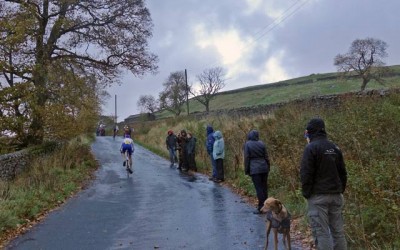
Cycling in the rain is really not as bad as it seems from the perspective of a nice warm cafe. Get some good waterproofs and you can keep yourself pretty dry. But, when all things are considered, you can’t escape the fact cycling in the cold wet is not the greatest advert for cycling. 

Rain

Rain

I admire people who live in rainy places like Ireland, and still manage to cycle everyday.(see: Rain Miles - a blog from Northern Ireland.) I like the tagline – rain miles count double.

It reminds me of the great Emil Zatopek, who was a great believer in training in adverse weather conditions. Personally, I try my hardest to avoid training in the rain. But, the rain doesn’t stop the short commute into town.

More Rain

More Rain

Turning Right in Rain

Turning Right in Rain

Well Equiped for rain

Well Equipped for rain

Related

Road Tax in UK

I was interested to read about a recent ‘I Pay Road Tax Campaign‘ (I have talked about this before – Should cyclists pay road tax) At the risk of repeating myself, here are some more thoughts on the issue.

I Pay Road Tax

I Pay Road Tax

Of course, nobody pays road tax because it was abolished in 1930. But, most adults will pay Vehicle Excise Duty (which is popularly known as Road Tax)

Cyclists are often criticised for not paying ‘road tax’ and this is a worthy campaign to raise awareness that we all effectively pay for the road and its maintenance. It helps to provide a defence against aggressive motorists who would like to see cyclists pushed off the road, because occasionally they have to slow down to overtake someone.

As well as being a cyclist, fortunately or unfortunately, I am an economist. One particular interest in economics is the concept of  optimising social welfare in the presence of consumption or production externalities. In an ideal world, externalities would be internalised through Pigovian taxes or subsidies to reflect the true social cost of different activities.

If I haven’t lost you already, – hang on. What does all this mean in practical terms?

There is a private cost of driving – petrol and taxes e.t.c. But, driving a car also creates negative externalities which are borne by society – not the individual driver. These external costs include:

  • - Congestion – estimated to cost the UK economy in the region of £22bn a year. A huge economic cost and also high personal cost of being stuck in traffic jams,
  • - Pollution – For example, CO2 emissions which contribute to global warming. Higher rates of asthma e.t.c
  • - Accidents. Motorised vehicles cost the lives of over 3,000 a year. Typically, cyclists may cause the deaths of 0,1 or 2 people a year.
  • Wear and tear on roads which increases disproportionately with vehicle weight.

For driving a car the social cost is much higher than the private cost. To get an efficient allocation of resources – to help reduce congestion, pollution and accidents, – the cost of driving should be much higher than the free market price. Petrol tax helps redress the balance, but, it is not enough to reflect the social cost.
externalities
External cost of driving

By contrast, cycling doesn’t have the same negative externalities. Therefore, the social benefit of cycling is higher than the private benefit. Cycling should be subsidised. The idea of taxing cyclists who don’t create the negative externalities would not make sense

In a free market, we get an overconsumption of cars (best illustrated by interminable traffic jams). When deciding to drive people ignore the external costs of driving. When cycling people underestimate the social costs. Therefore we get underconsumption of cycling.

To cut a long story short, cyclists shouldn’t be paying the same level of tax as motorists. It is possible to argue how high the external cost of driving is. But, I’d rather support a campaign where people who cycle to work get a subsidy equal to say £100 a year – (the cost of Vehicle Excise Duty.)

So maybe I’ll make a bike jersey which reads.

“Higher Pigovian taxes for Motorists! Subsidies for cyclists! Let’s try and achieve a Pareto optimal outcome on our roads!”

-  Now if that doesn’t sound catchy I don’t know what does!

BTW: I am a motorist, but, would welcome higher taxes on driving.

A Birthday Ride

cycling
Not me, and taken a few weeks ago in Yorkshire.

Today, was my 33rd birthday,  so for want of anything better to do, I cycled 90 miles towards Hungerford. I cycled south as I fancied having the pretty tough wind at my back on on the way home. It took about 4hrs 40, averaging about 18.5mph. I thought of making it a round 100 miles, but, the looming rain clouds soon put that idea on the back burner.

bleak
It was pretty bleak today, grey skies, autumn colour gone. This photo was taken a few weeks ago.
Alas, it can’t always be as picturesque as this!

For some reason, I always end up doing the longest rides in the middle of winter, November and December. Its been a good week for training. Two 30 mile rides on Sunday and Monday, 62 miles on Thursday and 90 miles today.

One thing I noticed is how many villages don’t have village shops these days. I kind of ran out of food 20 miles from home, and I thought, I’m bound to come across a shop on the way home, but, a succession of villages had no shops. So I just trudged on.

Different Faces of Cycling

photo

Photo by Scarlatti

Thor Hushovd and Mark Cavendish competing in a bunch sprint. The image captures the raw power, excitement and drama of the finishing stages of a cycle race

Cycling into Sea

Cycling into Sea

Photo by Riefolino

Aerodynamic Cycling

cycling

http://farm3.static.flickr.com/2670/4018006785_e61c470659.jpg
The Bernoulli Principle. Photo by Lee Sie

( Bernoulli’s Principle is the principle that allows wings to produce lift and planes and helicopters to fly.)

Related

Increase efficiency of cycling

Best Winter Tyres

tyres

For winter riding, I will choose 700*25. Even 25s are a little thin for winter conditions. At the moment it can be quite treacherous with wet leaves on the road. I take extra care not wanting to risk a broken leg.

For winter riding, the main thing is puncture resistance. I haven’t decided whether to put on Armadillos on my winter training bike. But Armadillo’s offer one of the best puncture protection. I have them on my commuting bike for nearly two years. They haven’t needed replacing (very hard wearing) and have only had one puncture (6 inch nail) which probably would have puncture a car tyre.

The disadvantage of Armadillos is that they are a little more sluggish and they are also quite stiff – hard to get on and off.

At the moment, I have Continental Ultra Gator Skin. Three levels of Kevlar puncture protection underneath tread. They are semi slick tyres so grip well.

I’ve not tried them myself, but Specialised All condition also look to be another good choice. They look similar to Armadillos and come in at a similar price to the other two at £22.99

As I’ve mentioned before, I always think tyres are one area not to skimp on. It really is worth paying £20 plus to get the best tyres. I know I’m happy to pay £20, to avoid getting a few more punctures…

Autumn Training and Photos

churchill

The village of Churchill in the Cotswolds

Saturday, 80 miles in the Cotswolds to Bourton on the Water. My longest ride of the year, quite enjoyable with weather remaining fair.
bolton-abbey-2

Bolton Abbeyburnsall2
Burnsall

Monday 40 miles to Grassington, Yorkshire Dales. Another beautiful day. I can’t believe how empty roads can be on a Monday afternoon in November. If you have the patience and time to wait for good weather, November can be a great time for cycling. It just became a stop start ride, as there were so many pictures I wanted to take.

cycling-dales

Cyclists were more common than cars on this back road.

Old Bikes

cycling

A rare photo from the nineteenth century, possibly in India. Including two good old Penny Farthings :)

What’s that Picture Flickr

Related

Reflective Clothing

reflective-gear

In my previous post – perspective of a motorist, I mentioned my biggest grievance about cyclists was that they were often difficult to see. The legal requirement is to have a light. But, a small light on its own is often difficult to pick out. There is no legal requirement for having reflective clothing, but, it could be very useful in protecting you. I would suggest that wearing reflective clothing is more effective in preventing serious injury than wearing a helmet. That is not to say I’m against wearing a helmet, but, as a rough analogy – its best to avoid getting swine flu in the first place, rather than hoping, the medicine will mitigates its effects.

Reflective Clothing and Fashion

I remember as a young boy, getting teased for putting some free Texaco reflective stickers on my state of the art mountain bike (well not really state of the art, but a definite step up from a cheap BMX). As a youngster, you are susceptible to peer pressure and that put me off reflective clothing for quite a while. Of course, you don’t need to put reflective stickers on your bike. But, as a you become an old man, the desire to look fashionable on a bike soon evaporates. True, I love the aesthetics of people wearing smart fashionable clothes (cycling in style). But, when it’s dusk / night, people aren’t really going to be noticing your D&G label. The important thing is that motorists notice you at all, let alone giving you a fashion rating out of 10.

Reflective straps are quite useful because they are light to carry around and you can put lights onto the strap. e.g Madison Reflective Straps

Time of the Day

The most dangerous period of the day for cycling is around dusk and night, especially in the winter months. This is the time to be wearing reflective clothing. In the height of summer, that is the time to show off your fashion style (if you have any)

Related Posts

Perspective of A Motorist

motorists

I have written frequently about the frustrations, joys and fears of a cyclist. Dealing with White Van DriversDealing with road rage e.t.c. So I thought it would be interesting to write from a perspective of a motorist.

Wherever, possible I try to cycle. For getting around Oxford, cycling is quicker, cheaper and more convenient. But, I do own a car and recently have been driving to certain events. I made a note of observing cyclists’ behaviour and how it affected me as a motorist. These were some observations from the perspective of a motorist.

Sorry I didn’t see You Mate

As cyclists we are all familiar with the dreaded phrase ’sorry I didn’t see you mate.’ This is far too often used as an excuse for careless / thoughtless driving. But, as a motorist you do realise how often cyclists can be genuinely difficult to see.

night

When you are driving in the dark, it can be very difficult to pick out cyclists wearing black clothes and no lights.

Also I notice that many cyclists use the feeblest possible lights. A small, rear light is almost indistinguishable when your are used to seeing car headlights. Sometimes, cyclists will have their rear light obscured by long clothes e.t.c.

As a motorist you appreciate when a cyclist is wearing reflective clothing because this is much easier to see than a flimsy backlight, especially from the side view.

Cyclists are not Really a Nuisance.

Of course, I’m biased. but, overall cyclists in the road are not really a problem at all. I like to leave cyclists alot of room when overtaking (do unto others as you would have done to yourself…) In practical terms this means sometimes slowing down from 30 to 15mph for a few seconds before overtaking at an appropriate time. But, cyclists do not cause your overall journey time to be any longer. It’s not like getting stuck behind buses at bus stops or stuck in an interminable traffic jams. The impatience to overtake cyclists is really misplaced, the impact on overall journey time is insignificant.

Critical Mass.

There is a big difference to driving in Oxford, where cyclists are numerous and a place like Bradford where cyclists are a rarity. The prominence of cyclists in Oxford means you are always looking out and looking in your rear mirror. But, when cyclists are a rarity, it is easier to get out of the habit and be surprised when one appears. This backs up reports which suggest more cyclists on the roads leads to safer roads. In a way the presence of cyclists encourages relatively more careful driving.

Cycle Lanes at Lights

cycling

I have mixed feelings about these cycle lanes which enable cyclists to go to the front of the queue. They can be useful when cycling. But, on when you are in the middle of a lane and you have cyclists or your inside and  on your outside, it leaves little room for manoeuvre.

Jumping Lights.

Ironically, when cyclists are squeezed in between lanes of traffic, it is almost a relief when they anticipate traffic light changes and jump the lights by a few seconds. I’d rather drive off with cyclists ahead than cyclists to the left and right of the car. On some occasions, a person on a bike will ride through a 4 lane junction completely oblivious to lights and force the motorists to stop in their tracks. Even an isolated incident can make you pretty annoyed at the arrogant road use. As a cyclist, myself, I don’t start generalising; I know the cyclist who makes traffic stop is probably the same person who will drive irresponsibly too. But, the reality is people do make generalisations.

Signalling.

A large portion of road users don’t signal. This proportion is higher amongst cyclists. It is frustrating when cyclists don’t look over shoulder and signal. Though, as a motorist I can usually anticipate at junctions that a cyclist may be wanting to turn left or right.

Jealousy
cycling

Because I’m so used to cycling, I don’t like getting stuck in a traffic jam – I start thinking if only I had the flexibility of a bike to sneak down the inside.

Pride

It works both ways. When its chucking down with rain in the cold winter months. I can’t help sometimes feeling glad I’m not on the bike….

Buses are a Real Pain.

On Oxford’s narrow roads, it is buses which create the most congestion. Stopping at every bus stop causes traffic on narrow roads to come to a standstill.

Conclusion

It was an interesting experience – trying to empathise with the view of a motorist to get a different perspective on cycling. Yet, my driving experience is completely dominated by my experience cycling on roads. As a cyclist, I instinctively have patience when overtaking cyclists and am more tolerant of foibles like failure to signal (sometimes you are just trying to concentrate on staying upright e.t.c). Generally, cyclists don’t create a difficult experience for motorists, in fact the presence of cyclists can encourage more alert driving. But, there are times when you get annoyed with some cyclists. In particular, cycling at night in dark clothes / no lights is a real problem which cyclists and the police should address.

Like anything, you see responsible cycling and irresponsible cycling. But, unfortunately, it is the minority cyclists completely ignoring traffic signals which stick in the memory.

Also, I would be quite happy for special constables to look for serious road infringements – not focusing on cyclists. But, just looking for dangerous behaviour from any road user. I think even the threat of regulation would make both cyclists and motorists behave better.