Entries Tagged 'equipment' ↓

How To Fit a Bike Helmet

The great debate about cycling helmets is not likely to disappear. But, when cycling around Oxford, I am often surprised to see alot of people who wear a helmet, fail to wear it properly. If you do make the effort to wear a helmet you might as well wear it properly.

Incorrect Fitting of Helmet

helmet-the_amanda

from: flickr

In particular the most common problem is to wear the helmet too far back on the head. If you were to land on your forehead the first thing to hit the ground would be your head rather than your helmet. The other mistake is to wear the helmet too loose. It is suggested that badly fitting helmets can actually cause injury when you fall because they can twist your neck.

Tips for Correct fitting of Bike Helmet

Continue reading →

How Often to Change the Chain on a bike?

I have several bikes and cycle about 10,000 miles a year. Knowing when to change the chain is sometimes a difficult question.

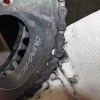
A simple test  is to use your finger and try to lift the chain off the chainring. If the chain can be pushed quite a bit away from the chainring, this is a sign that it needs changing. If the chain is badly worn, you will probably need to change the cassette block at the same time. (and possibly front chain ring)

You can also buy a chain measuring tool which will tell you how worn a chain is. Such as this Park Chain measuring tool for £19.99.

Chain on My Commuting Bike.

With my commuting bike, I usually wait until the chain starts to slip and then change the chain, cassette block and front chainring altogether. It means that it can be 1 or 2 years between changing the chain. Towards the end of the chain cycle, it is probably becoming inefficient. But, the hassle of changing it is greater than the decrease in inefficiency. However, if it starts slipping, it is definitely a sign it needs to be changed.

Recently, I kept putting off changing the chain on my commuting bike and really notice the difference now I did it at the weekend. I wish I had done it earlier because it makes a much more pleasant ride.

Time Trial Bike / Road Bike

On my road bike and time trial bike I have a Dura Ace groupset, and so want to try and

  1. Extend the life of the cassette blocks
  2. Not lose any inefficiency in the drive mechanism.

Continue reading →

Bottle Cages for Bike Review

Tacx Tao Bottle Cage

One of the best value bottle cages on the market is the Tacx Tao bottle cage. They are strong, lightweight and cheap. It weighs 37grams and can be bought for just £7.99. Some of the more expensive carbon fibre bottle cages may be 5-10grams lighter, but, they can be more than triple the price; they become an expensive way to save 10 grams. I use tacx tao bottle cages on my road bike and training bike. They look pretty good coming in a either black or silver. Another reason to choose Tacx tao, is that the ultra light weight carbon fibre varieties can be a bit flimsy and I had one break in the middle of a race. -  

Continue reading →

Tips for Better Pedalling Technique

Cycling is beautifully simple. Basically, we pedal and keep the bike heading in the right direction. Because pedalling is such an intrinsic part of cycling, it is important to optimise and perfect our pedalling action. Especially for beginners it is important to work on our pedal action.

These are some tips to Improving Our Pedalling Action

1. Make Sure the Saddle height is correct.

See: Correct saddle height and bike frame size

2. Make Sure You Pedal with the balls of your feet.

Beginners often make the mistake of pedalling with the middle of your foot (by the arch) or even their heel. This is an inefficient method of pedalling.

3. Watch the Pros peddalling.

It is a good idea to watch experienced professional cyclists pedal. You will get a feel for the fluidity of movement and correct position.

4. Pedal Both Down and Up.

It is important not just to pedal on the downstroke. It is also important to pedal on the upstroke. Thus ideally we will be pedalling for the 360 degrees of a pedal stroke and not just on the downward part. To do this we will need toe clips or the more popular clipless pedals.

5. Seek Professional Help.

A couple of years ago I paid about £130 to get a professional bike fit at cycle fit. As well as working on best position, they also took a video of my pedalling action and suggested a few minor changes.

Continue reading →

Tips for Fitting a Tyre

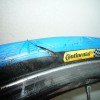
Recently I bought some of the new Continental Grand Prix 4000 Tyres. They are pretty good and claim to have lower rolling resistance, improved puncture resistance and also have a gauge to recommend when you should replace them.

However, they were a bit difficult to fit and I have a blister on my thumb to prove it.

These are some ideas, which in theory, should help to make it easier to fit a new tyre.

  • Squeeze the opposite side of the tyre. If you squeeze the tyre down towards the rim you make it wider, and it becomes easier to squeeze the tyre on. It is helpful  if you go all around the tyre pushing the tyre closer to the side you wish to fit.
  • Using Palms. After trying for ages with using my thumbs I got it on first time by using my palms to push it on.  Continue reading →

Speedplay Pedals Review

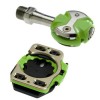
speedplayOnce you have got used to clipless pedals you won’t want to go back. My first clipless pedals were the more common Look pedals. The reason I switched to speedplay pedals was:

  1. I had some problems with my knees and (rightly or wrongly) I blamed the Look pedals and the way movement was restricted. I liked the idea of having a large angle of float that comes with speedplay
  2. I wanted to save weight. Speedplay come in at 205 grams and 150grams for Titanium version. These are the lightest pedals on the market. However, the gap between speedplay and Look has been reduced with the introduction of new models like the Look Keo. At 280 grams + cleats they offer good value for money at only £39.99 link for Keo
  3. Easier to Maintain. I always found the look cleats a bit fiddly to get in the right position. Speedplay are much easier because of the greater degree of lateral movement.

Continue reading →

Best Ways to Save Weight on A Bike.

When I was developing my hill climbing bike, I used to spend hours working out the best way to save weight on a bike. I developed a system for calculating the cost per gram saved. Among the best things to change was buying a lighweight saddle and seatpost. This offered the best way to save weight for the least money. The most expensive way to save weight would be to do something like upgrade from an Ultegra groupset to a Dura Ace groupset. Here the cost is very high and the weight saving low. Make sure you prioritise and remember to do the most efficient changes first.

Seat Post:
Deda Elementi Ultra Seatpillar weight 260g only £23.99

Saddle:

Selle Italia SLR XP £53.99 weight 190 grams link

Continue reading →

Quick release Skewers

Not the most glamorous part of a bike, but, if you become fanatical about losing weight on a bike (like me) it’s fun to look at every possible way of reducing weight. Most bikes I just use the standard ordinary skewers, but for my racing and hill climb bike I use some very lightweight spin sticks. For time trials, the ideal would be to not use quick release at all. The standard nuts and bolt provide better aerodynamics. But, for general cycling convenience, quick release skewers are a great development.

Continue reading →

Mavic Kysrium Wheelset

I have ridden Mavic Kysrium wheel’s for a couple of years and they are a pretty versatile and reliable wheel. I once had a problem with the bearings, which needed fixing but apart from that they are quite sturdy.

The advantages of the Mavic Kysrium’s include

  • Light enough to race. I have used them for hillclimbs, (although I now use Zipp 404 tubulars.)
  • Strong and reliable for year round training.
  • Look good. I don’t know why but I love the look of the silver straight spokes.

Continue reading →

Which is Better Tubulars or Inner Tubes?

I use both tubulars (tubs) for short and the more conventional inner tube /tyre combination.

Apparantely tubs, use to be a lot more popular, but most bike shops don’t seem to even stock them any more.

Advantages of Tubulars.

  1. More Puncture Resistant. They seem to be better at avoiding ’small’ punctures from a small bit of glass. If you get a 6 inch nail, tubs will be no more resistant than the average tyre, but they do seem a little better at avoiding punctures. Also you don’t have to worry about the puncture through the ‘pinching’ effect.
  2. You can inflate them to a Higher Pressure. Most road tyres are good upto 120 psi. But, tubs can seem to go as high as 180psi. This is good for people doing time trials, who may get some benefit on relatively smooth roads. I will ride at a bout 120-140 in British time trials.
  3. Wheels can be a bit lighter, because you don’t need so much of a rim. Not a big issues unless your a specialist hill climber like me.

Continue reading →