Entries Tagged 'training' ↓
October 14th, 2008 — training

My racing season is winding down, but, I’m still doing some interval training for the remaining hill climbs. These are some of the training sessions I like to do.
Train like a Race
One of my favourite type of interval training is just to ride up a hill as if it was a race. This enables you to check your times and see what kind of improvement you are making. The length of the hill will determine the intensity of the hill. If it is a short hill which takes 2 minutes, it is pretty much a sprint. In this kind of session you will be getting are trying to get close to your maximum heart rate / effort level. After doing one all out effort, you will never be able to replicate the same effort level in other intervals.
Do As Many as You Can.
Another way to do hill intervals is to race up a hill pretty much as fast as you can. Measure your time and then try to ride up the hill as many times as you can, keeping within 20% of the initial time. For example, if the first hill interval takes 3 minutes. See how many times you can then ride the hill in under 3 minutes 30 seconds. It gets harder and harder and means you work on the ability to race with lactic acid in the legs.
Train With Other People.
Sometimes when you train with others it might inspire you to try a little harder. There is nothing better than a bit of competition to motivate yourself to keep training hard. It can be difficult to find someone of similar ability, but is good if you can.
Fartlek.
Fartlek is just when you go on a training ride and sprint for certain signposts or the crest of hills. It is an unstructured form of interval sessions as the gap between intervals is not fixed but it makes it a bit more interesting.
Pyramid.
Pyramid is where you start off with intervals of a certain intensity say 80% of your heart rate (or you can use a power output, if you have a power metre). Then in the next interval, you increase the intensity to say 85% of your heart rate. Then 90%, 95%, 98% before reducing the intensity back down to 80%. This kind of closely monitored session is best to do on a turbo. I can’t say I ever do it.
When you are doing this kind of interval sessions, you really have to learn to listen to the body. Sometimes, you just can’t maintain effort levels close to your maximum. It is better not to force it. But, if you do feel strong, it is good to make most of the day. Also, I don’t advise getting into a routine of doing intervals every week. It is the kind of training good to do in cycles. Some months off, some months on.
August 16th, 2008 — training

When you have been training very hard, it can seem counter intuitive to hold back and train less. But, scientific and empirical evidence suggests the correct tapering is the most effective way to get the best performance on the day. I believe Chris Boardman made effective use of this tapering principle, at a time when it was less valued than it is now.
Victoria Pendleton talked about the tapering British athletes use [link]. 6 days before the race it involves taking 2 days of complete rest, followed by 2 days of training then a final 2 days of virtual rest. In the last training sessions, the duration of the training is gradually reduced, although the intensity is maintained. Victoria says that this taper is worth alot:
“If I have two days’ rest, I can go half a second faster than I was in training. And half a second on the track is massive.”
It is argued that Olympic trials often disrupt an athlete’s preparation. if you have to peak for the trials 2 months before the Games, it becomes more difficult to peak a second time, 2 months later. If an athlete doesn’t have to worry about Olympic trials then can train throughout the season, peaking just once.
My Tapering
My Peak for the season will be the last weekend in October for the National Hill climb championship. It makes it a long season. By the end of October, a tapering period feels like common sense as the dark winter nights and season long fatigue, encourage an instinctive taper anyway.
A tapering period can begin 2-4 weeks before the final race. Usually, an athlete will be training with tired legs; the training volumes never allow muscles to fully recover. An effective taper means that the muscles will be fully rested on the day of the event. This gives them a freshness lacking at other times of the year.
July 19th, 2008 — training

This the amount of food I took for a 3 hour 60 mile bike ride. I ate everything but 2 bars. It’s always better to take too much than too little
- Mostly I use muesli bars and nutri grain bars. They are not specifically designed for cyclists and so are cheaper. They have a similar food composition to the more expensive energy bars. However, I still like to take 1 or 2 Power bars on long rides.
- I use Liquid energy gels particularly when doing interval training. It helps to replenish energy quickly without being heavy on the stomach.
- Bananas are good for variety and natural fruit sugars.
- People might be surprised how much you can get through on a 60 mile bike ride. It might be better to take energy powder in my water, but, I have never been keen on that; I’m not sure why really.
- I have 2 750ml water bottles. This is just about enough for me, though on really hot days I would probably need to buy some more on route.
Related
July 9th, 2008 — cycling, cycling photos, training

Looking towards Burnsall
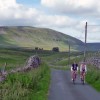
I spent a few days In Yorkshire. Fortunately, first day was fine. I cycle 95 miles from Menston to Burnsall, Buckden, Fleet Moss, Hawes, Asygarth and back down through the Wharfe Valley. I averaged 18.5mph and really enjoyed it. The first 60 miles I did as training; but, then after a tea stop in Kettlewell, I took it easy on the way back. It’s good to just enjoy the scenary for a change!

View from Kettlewell looking towards Grassington
Fleet Moss Climb from Hubberholme to Hawes

View from the top of Fleet Moss, the highest road in Yorkshire. This is another cyclist I overtook on the long and hard 17% climb. It was a great descent down the other side into Hawes (20% and straight). I got a maximum of 53mph.
Continue reading →
June 11th, 2008 — training

Bourton on the Water in Cotswolds
So far this year I have been training about 3 - 4 times a week. With this kind of training schedule, I wasn’t really doing many recovery rides because, the recovery was on the day off (when I would just have to cycle 2 miles to work) However, now that I am training more frequently, I am incorporating recovery rides into the weekly programme.
Often I don’t plan any training schedule, but, see how I feel. On saturday, I cycled a fast 80 miles in about 4 hours (averaging 20mph) This included racing up some hills around Stow on the Wold in the Cotswolds. When I went out on Sunday, I soon realised this was going to be a recovery ride. I just didn’t have the legs to do anything else!. I averaged about 16.5 mph for 40 miles. I didn’t feel like going any faster. If I was used to training 5-6 days a week, my legs may have been less dead. But, I still think it’s good to have recovery rides in any programme.
Continue reading →
May 28th, 2008 — training

I remember in my first season of racing, I made tremendous progress. There was one patch where every time I raced, I seemed to set a personal best. I imagined this upward trend continuing and at this rate, I reckoned I would be in the Tour de France by about 2008. Well, of course, I’m still here and progress is not as simple as we would like to hope.
Often after a great first season, we will find that our performance stagnates or even appears to go backwards. This can be demotivating and it is important to work out how to deal with this.
1. It is quite natural. Everybody will have this experience at some stage. We cannot expect consistent progress in a straightline. To make progress we have to expect to go backwards at times.
2. Don’t be demotivated Don’t be demotivated by a feeling you are going backwards. Don’t dwell on a disappointing set of results, it is important to move on and think of the next race. These set backs are just as important to our progress as the times when we do better than expected.
3. Alter Training schedules. Don’t always stick with the same training routine. Consider doing something quite different. Either longer distances, shorter distances or even taking a break.
4. Are You Overtraining? As we train more, it becomes just as important to rest and allow sufficient recovery. Sometimes stagnant performance may be due to overtraining. Taking a short break may actually help us to regain our progress. See: Tips to avoid overtraining.
Continue reading →
May 14th, 2008 — training
It is a long time since I did a proper time trial. It was not in a race, but, in training I gave a maximum effort for 16 miles on a hilly time trial circuit around Brill. When I returned home I felt quite exhausted; but, curiously it was a great feeling. There is something quite satisfying about pushing yourself to your limit. My legs felt the effort for the next 2 days, especially walking up the stairs. It was not like the feeling after doing my first 100 mile time trial; but, it was a good reminder of what it is like to transcend and push yourself. It has motivated me to do some more races when I become less busy. The only problem with a really big effort is that sometimes it can be difficult to get up the next day in the morning.
Principle of stress and recovery
The Giro d’Italia started this week. I guess in a three week stage race, the riders must feel pretty exhausted at the end of every day. I was interested to read Bradley Wiggins regards the three week stage race as good preparation for the Olympics - where his main event is the 4Km pursuit. That’s a lot of miles just for a short race.
May 9th, 2008 — training
One of the basic principles of training is the concept of stress and recovery. What this means is that we start off by riding faster / further than we are used to. This stretches the muscles beyond their previous capacity. This makes the muscles (of both the heart and legs) grow and become stronger. However, in the process of stretching the muscles we also damage them. This is why it is necessary to allow a period of recovery for the muscles to rehabilitate.
What This Means
- For interval training to be Most Effective, you shouldn’t do it everyday. Relief! It is best to leave a gap of 1 day or 2 days for really intense interval sessions.
- Don’t do Too Much At Once. Training is a continual progress. If we are new to cycling, we should get the muscles used to riding before really strenuous exercies.
- Recovery is an important aspect of getting fitter and stronger. We tend to associate recovery with wasted time. But, it may be just what we need.
- The Stress and Recovery Cycle doesn’t just apply to days of the week. It is is good to think in terms of 4 week cycles. Vary the intensity of your week’s training; after 3 weeks of hard training take a week of lighter training.
- To Taper for a Race, the stress placed is less and recovery is given a higher importance.
- To make improvements we need to cycle faster than we are used to. i.e. even if we cycle 400 miles a week, we may not get faster in a time trial. If we want to go faster we have to train at a pace equal to or preferably higher than race pace. This is how real improvement will come.
Other Notes
- One of the best way to recover from a hard interval training is to have a moderate ride the next day. Recovery doesn’t have to involve complete rest, in fact it is better to keep the legs ticking over. In the Tour de France, the riders will still ride for 2 hours on the tour rest day.
- This principle doesn’t mean you can’t still race for 2-3 consecutive days. Think of the big tour riders, they are racing for several consecutive days, and there are pretty fit at the end!
Related:
May 1st, 2008 — cycling, training
When I first began cycling, I felt nervous about cornering on descents and so felt of myself as a ‘bad descender’. However, over time, you imperceptibly pick up on how to corner, learning to understand how you can corner faster without risking falling off.
1. Practise on Hills You know well.
On hills that you use regularly, try each time to apply the brakes a little less. This is the best way of gaining more confidence to descend quicker. Gradually, you realise a reasonable speed for descending corners.
2. Braking before a tight turn.
It can be dangerous applying brakes in the middle of a tight turn, you can easily lose balance. It is better to begin braking before the turn and then accelerate out of the turn.
3. Use Both Brakes.
Braking lightly with both brakes is more effective than pressing hard on front or rear brakes. It is good to also try and use the on off technique. This prevents brakes overheating, useful for long descents.
4. Lean the Bike.
This takes a bit of practice but, if you lean the bike into a corner, you will be surprised at how much you can corner without the need to brake. Leaning the bike is much better than just leaning the body.
5. Ride With Experienced Riders.
If you ride with quick descenders you will gain an idea of how to descend. You could try following their ‘race line’; not necessarily at their speed, but you will get confidence from following their descent.
Continue reading →
April 25th, 2008 — cycling, training
These days, I often don’t bother with a heart rate monitor, but, I am still conscious of different heart rate training zones and try to get the right mix between them. If you want to use a heart rate monitor, it is first necessary to find your maximum heart rate. These training zones may vary somewhat depending on your base level of fitness.
Lactate Threshold Training level about 90% of Maximum Heart Rate. The lactate threshold level is the level at which exercise creates the build up of lactic acid faster than it can be replaced. Lactic acid eventually becomes a deter ant to performance; getting used to riding with lactic build up is essential to improving race performance.
Time Trial Zone. When racing flat out for a 1 hour time trial. The typical heart rate will be 92-96% of your maximum. Clearly for a short 10 mile time trial it will be easier to maintain a rate closer to 92%. For longer time trials you typically start off at a high heart rate and then over the course of the race the heart rate very slowly declines. For long races it is important not to get despondent about this. The important thing is not to go off too fast and blow out in the first 10% of the race. Continue reading →