Entries Tagged 'training' ↓
May 1st, 2008 — cycling, training
When I first began cycling, I felt nervous about cornering on descents and so felt of myself as a ‘bad descender’. However, over time, you imperceptibly pick up on how to corner, learning to understand how you can corner faster without risking falling off.
1. Practise on Hills You know well.
On hills that you use regularly, try each time to apply the brakes a little less. This is the best way of gaining more confidence to descend quicker. Gradually, you realise a reasonable speed for descending corners.
2. Braking before a tight turn.
It can be dangerous applying brakes in the middle of a tight turn, you can easily lose balance. It is better to begin braking before the turn and then accelerate out of the turn.
3. Use Both Brakes.
Braking lightly with both brakes is more effective than pressing hard on front or rear brakes. It is good to also try and use the on off technique. This prevents brakes overheating, useful for long descents.
4. Lean the Bike.
This takes a bit of practice but, if you lean the bike into a corner, you will be surprised at how much you can corner without the need to brake. Leaning the bike is much better than just leaning the body.
5. Ride With Experienced Riders.
If you ride with quick descenders you will gain an idea of how to descend. You could try following their ‘race line’; not necessarily at their speed, but you will get confidence from following their descent.
Continue reading →
April 25th, 2008 — cycling, training
These days, I often don’t bother with a heart rate monitor, but, I am still conscious of different heart rate training zones and try to get the right mix between them. If you want to use a heart rate monitor, it is first necessary to find your maximum heart rate. These training zones may vary somewhat depending on your base level of fitness.
Lactate Threshold Training level about 90% of Maximum Heart Rate. The lactate threshold level is the level at which exercise creates the build up of lactic acid faster than it can be replaced. Lactic acid eventually becomes a deter ant to performance; getting used to riding with lactic build up is essential to improving race performance.
Time Trial Zone. When racing flat out for a 1 hour time trial. The typical heart rate will be 92-96% of your maximum. Clearly for a short 10 mile time trial it will be easier to maintain a rate closer to 92%. For longer time trials you typically start off at a high heart rate and then over the course of the race the heart rate very slowly declines. For long races it is important not to get despondent about this. The important thing is not to go off too fast and blow out in the first 10% of the race. Continue reading →
April 23rd, 2008 — training
Maximum Heart rate is not an indicator of fitness. Maximum heart rate’s can vary by 10% between similar ability cyclists of the same age. A very rough guide to maximum heart rate’s is given by the formula 220-age. But, this is likely to be inaccurate by upto 15%. If you are serious about using heart rate % for training it is important not to use this formula.
The only way to find your maximum heart rate is to monitor your heart rate at your maximum effort level.
To ride at your absolute maximum requires a good level of base fitness. If you are new to cycling forget about finding your maximum; you can always find it later when you have got used to riding at high levels.
Because of the nature of this exercise, it is best done on a stationary indoor trainer, but it can be done outside on a quiet level. Because your effort levels will be at peak rates, it is important to have a good fan to prevent overheating.
Warm up for 15 minutes at a steady rate. Then every 2 minutes increase your workout by 10% when you get to roughly 85% of your heart rate, you can sprint fast out as fast as you can; you should be able to do this for about a minute. It is important to always try and increase the effort levels; when you feel there is absolutely no further that you can go this should be pretty close to your maximum. You can repeat the exercise 3 times to see whether another day can give a different maximum. Some days there may be reasons which prevent our maximum being reached.
April 2nd, 2008 — holidays, training

I have a week off teaching, so I am spending a week in Yorkshire, with my parents.
Today I cycled 70 miles to Otley, Pately Bridge, Lofthouse and Burnsall. It is very hilly; in particular greenhow hill out of Pately Bridge is really tough. It has about 4 sections of 16-20%. After 10 minutes of climbing the gradient flattens a little, but with a strong headwind it was still very tiring by the end. Earlier in the ride, I also climbed Norwood Edge from Otley towards Pateley Bridge.
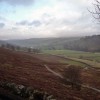
There is a good cycling road from Pately Bridge to Lofthouse. This road is rolling and takes in the beautiful Nidderdale Valley, which is characterised by the above picture. At Lofthouse there is a very sharp climb over to Masham or you could visit ‘How Steen Gorge’ a series of caves. I decided to race up a river valley to Scar House reservoir. It took 15 minutes, but the gradient is always very gradual. Continue reading →
March 27th, 2008 — training
At the start of the season I was training 3 times a week. Now I am trying to increase the number of times I go out training. There is always some reason to prevent training every day. But, I am going to try and train 5 times a week, even if I only go out for an hour.
Yesterday, I did 3 intervals up boars hill in Oxford. the climb takes about 2.5 minutes. Ideally, I would be doing longer intervals at this time of the year. My forthcoming races are 10-30 mile time trials; my time trial speed is very poor at the moment, mainly because i haven’t done any time trial training.
First Race of the Season on Saturday- Oxonian CC 31 mile Hardriders Time Trial
Pleased to see a good turnout for the race. Also pleased to see the Arctic Shorter boys riding in the team classification (3up time trial). It gives me a better chance of finishing higher up the overall classification
hopefully the weather will improve. I don’t fancy doing 31 hilly miles in the cold wet.
P.S. Congratulations to teammate Ed Silverton, Ed finished 2nd in a 4th Cat Road race at Castle Coombe. Earning the first placing for Sri Chinmoy CT in a road race.
March 13th, 2008 — training
A chain gang is a common term for a fast training ride with riders riding in two parallel lines, taking it in turns to work on the front and then slipping back to the back of the group. It is fast and an excellent way to improve both your fitness and your bike handling skills.
The idea of a chaingang is to keep a constantly high pace, with each rider doing a turn on the front and then smoothly moving back down the line before coming back up on the outside. When it works well there a constant smooth flow of riders going up and down the line. For a novice, it is not straightforward and if you have no clue, you might end up with people shouting at you for disrupting the flow of the ride. However, it is worth persevering and learning the basic etiquette of chaingang riding.
Tips for Riding in a Chain Gang
- Keep the pace constant. Allowing for variation is wind and gradient, try keep the pace constant. When you get to the front, don’t sprint off. That will break up the rhythmn and is not the point of a chaingang. Also avoid slowind down.
- Don’t allow gaps to appear. Concentrate on keeping an eye on the wheel in front, don’t allow a large gap to develop because it can then be hard to meet the gap.
- Don’t cut up riders. The tricky part is coming to the front. The rider on the outside will overtake the rider on the inside and as he does will move across to the inside. It is important to time this correctly, don’t move inside too soon as you will cause the previous rider to have to slow down. Don’t leave it too late as this will also create problems.
- Make sure you are used to following a wheel at pace before joining.
- If it is your first time you could stay at the back and observe how people make changes.
- Once you get the hang it seems quite natural and creates a good feeling of teamwork. You can see the advantages of riding behind others.
- Don’t go out with a group who are much fitter than you. If you are struggling to keep up, it is more likely you will make a mistake.
- Make sure your bike is well maintained. Don’t have lose or rattling bits, people will trust you less.
- Be careful about braking, it creates a ripple effect which can be dangerous at high speed. Use your body to slow down.
- Know the circuit. Learn the local chaingang circuit and practise the descents so you can know potential dangers.
- Remember it is not closed roads. It is difficult to find any circuit which is not populated with heavy traffic. You have to give way to traffic, just because you are in a chain gang doesn’t mean you can expect cars to wait for you.
March 12th, 2008 — training
My Weather forecast for the next three days. (except the wind is closer to 30mph at the moment(

When your cycling for pleasure, there’s not much incentive to go out in a forecast like this. At least the rain is not cold, the worst is a combination of rain and 3 C.
When the forecast is very bad, I often go out and do some intervals. These sessions can be quite short; in one hour you can do alot of hard efforts. During one hour you can’t get too wet and if you’re sprinting up a hill, rain seems only a minor inconvenience.
The main drawback to riding in the rain is that it is very difficult to get any suitable waterproof clothing. A truly waterproof jacket inevitably starts to sweat inside (at least when you are cycling hard). Waterproof trousers are fine for a 2 mile commute into town, but useless for proper cycling.
Generally, if it is raining, I don’t go out. But, there have been many occassions where it is started to rain in the middle of cycling.
Racing in the Wet
My first 50 mile time trial was a very testing experience. - It rained for the whole 2 hours. Luckily I had the foresight to wear alot more clothes than usual, this was just about enough to prevent me getting too cold. Although, I have never been so glad to see the finish line.
Turbo Training?
Admittedly, the alternative to training in the wet is getting on your turbo trainer and riding for a couple of hours. Generally, I prefer the rain.
March 9th, 2008 — training

On Friday afternoon, I did two hill intervals. The first was up the A40 to Stokenchurch (5.47) with tail wind. The second hill was up the 5 mile ascent from Wycombe to Stokenchurch the other way. It took about 16 minutes. The ride home from Stokenchurch is about 20 miles. I must have got cold after the hill intervals because I developed a permanently runny nose. The runny nose didn’t stop for about 12 hours after the ride. I thought I might have caught a cold, but a runny nose was the only symptom. Today, I cycled to Long Hanborough and did 2 circuits of a hilly time trial circuit. Quite slow but felt fine. Looking forward to the start of the racing season which is coming soon.
Often at this time of the year, the temperature can drop quite sharply after 4pm. When I set out at 2pm it was warm but later on it is was pretty cold. I should have worn more wicking layers.
March 6th, 2008 — training
I often find myself training on my own. But, I was introduced to cycling largely through the traditional British club run. It was interesting to pick up on a few tips and cycling ‘etiquette’. If you are relatively new to cycling, you might appreciate some of these ‘rules’ for group riding.
Ride Together.
If you do decide to ride with a group, don’t go sprinting off for road signs. Either do interval training on your own or ride as a group. Don’t try to combine both, you will just break the spirit of the group. (Unless your particular group encourages people to sprint for road signs.
Avoid Swerving
The first thing to remember when riding in a group is that your riding, will affect other group riders. Therefore, avoid making sudden movements to right or left. Try to anticipate objects and don’t leave it to the last minute. If you do make a sudden swerve it will ripple through the group and could be dangerous.
Keep Your Line.
If you ever do a road race, you will inevitably hear people shouting - ‘hold your line’. When your riding on your own, you can take the best line. However, when riding in a group, you have to bear in mind the people to the side of you. Make sure you don’t force them over the other side of the road by moving away from the inside.
Continue reading →
March 4th, 2008 — training
February training went reasonably well. I was able to do about 500-600 miles. Not a huge amount, but, enough to get reasonably fit. In the past couple of weeks I have started to do my first tentative interval training. Nothing at peak effort, but, a bit to get accustomed to the shock of racing. In the next few weeks, I will do some 10 mile race sessions. These are preliminary race training events. I usually don’t have the motivation or fitness to go flat out. But, it makes it less daunting doing your first race, when you have a few ‘mock’ races under your belt. I often like to choose some hilly courses. If I do a proper 10 mile time trial I just get depressed as I struggle to do something under 25 minutes.
Towards the end of the month I hope to do my first races, probably hilly time trials in the local area.
The Procycling season has got under way. Amongst other races that interest me include: